Skip to content







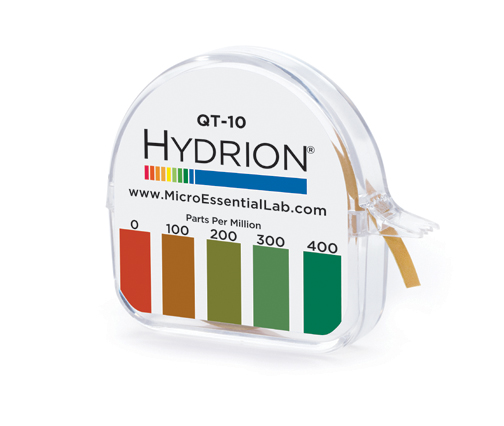
Hydrion QT-10 Quaternary Ammonium Test Strips 0–400 ppm
Store details
3500 Woodland Ave.
Cleveland OH 44115
United States
Hydrion QT-10 Quaternary Ammonium Test Strips 0–400 ppm
Quaternary ammonium sanitizer concentration has to fall within a specific range to meet health department standards — too weak and it doesn't sanitize, too strong and it's a food safety violation. The Hydrion QT-10 quat test strips give restaurants, institutional kitchens, and foodservice operators a fast, straightforward way to confirm quat sanitizer strength on the spot. The roll fits in a plastic dispenser with a serrated edge for easy tear-off, and a color chart is included right in the kit.
- Tests quaternary ammonium sanitizer solutions at 0, 100, 200, 300, and 400 ppm — covers the full range health departments typically require
- Compatible with alkyldimethylbenzyl ammonium compounds, Rocall II, and Hyamine 3500
- 180-inch (15-foot) roll of 5/32-inch-wide test paper per dispenser — enough for frequent daily testing
- To use: immerse the strip for 10 seconds in solution between 65–75°F, then match to the enclosed color chart; solution should be pH 7.5 or below
- Will flag exhausted or out-of-spec solutions, not just confirm good ones — catches problems before a health inspector does
- Federal, state, and local health regulations require quat sanitizer users to have a test kit on hand; this satisfies that requirement
Keep a dispenser at each sanitizing sink or prep station. During a health inspection, having documented proof that your team tests sanitizer concentration is as important as the concentration itself.
Specifications
| Manufacturer Part Number | QT-10 |
|---|---|
| Test Range | 0–400 ppm |
| Measurement Increments | 0, 100, 200, 300, 400 ppm |
| Compatible Sanitizers | Alkyldimethylbenzyl ammonium compounds, Rocall II, Hyamine 3500 |
| Roll Length | 180 in (15 ft) |
| Roll Width | 5/32 in |
| Test Solution Temperature | 65–75°F |
| Test Solution pH | 7.5 or below |
 WARNING: This product can expose you to chemicals which are known to the State of California to cause cancer and birth defects or other reproductive harm.
For more information, visit
www.P65Warnings.ca.gov.